A sample text widget
Etiam pulvinar consectetur dolor sed malesuada. Ut convallis
euismod dolor nec pretium. Nunc ut tristique massa.
Nam sodales mi vitae dolor ullamcorper et vulputate enim accumsan.
Morbi orci magna, tincidunt vitae molestie nec, molestie at mi. Nulla nulla lorem,
suscipit in posuere in, interdum non magna.
|
Warrior Publications has posted a story about the on-going Mi’kmaq resistance to exploration for fracking sites.
Burning tires, they argue, is a tried-and-true tactic for effective street protest and popular resistance. The pollution from the tires? A necessary evil and less than would be produced by fracking.
Here’s the full story, with brilliant photos:
December 4, 2013 · 12:30 PM
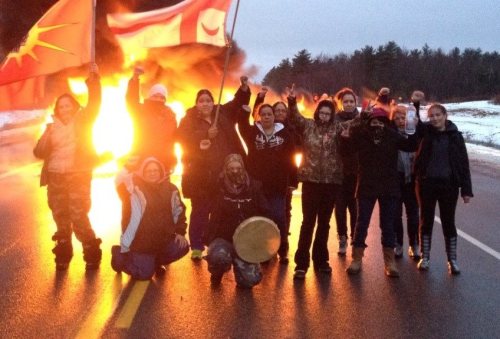
Women warriors at a tire fire blockade on Hwy 11, Dec 2, 2013.
by Zig Zag, Warrior Publications, Dec 4, 2013
After three women were injured by an SWN vehicle on Monday Dec 2, and 11 people arrested by the RCMP, Mi’kmaq warriors established several burning tire blockades on Highway 11. The fires burned into the night and served to delay SWN vehicles from proceeding with their exploratory testing. Because it has been an effective tactic, another burning tire blockade has been established today.
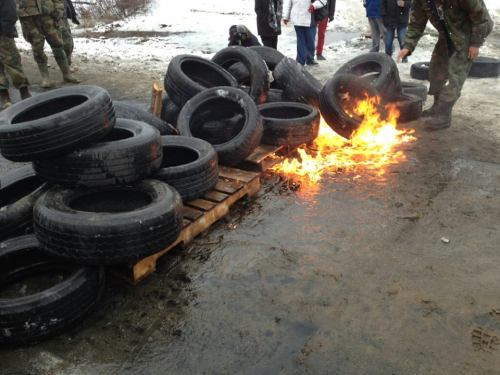
Establishing another tire fire blockade on Dec 4, 2013.
Many people are commenting on social media about the toxic effects of burning tires, and portraying this action as hypocritical for land defenders to engage in. The vast majority of these people, of course, are not present at the blockades but sitting comfortably at their computer keyboards. I doubt most have ever been in a serious confrontation with riot police or faced daily assaults as the Mi’kmaq have.
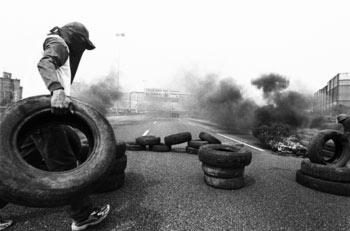
Piqueteros in Argentina establishing a fire tire blockade, 2000.
Tire fires are commonly used by resistance movements because they are effective in shutting down transportation routes, such as roads and highways. The piqueteros in Argentina, for example, used tire fire blockades extensively in the late 1990′s and early 2000′s. They would arrive at major highways, roads or streets, place tires in the street and set them on fire. They would remain until police mobilized a large enough force that threatened the blockade and then disperse. Through coordinated actions they were able to paralyze much of the transportation infrastructure during major mobilizations.
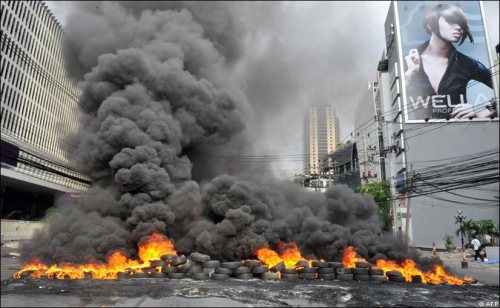
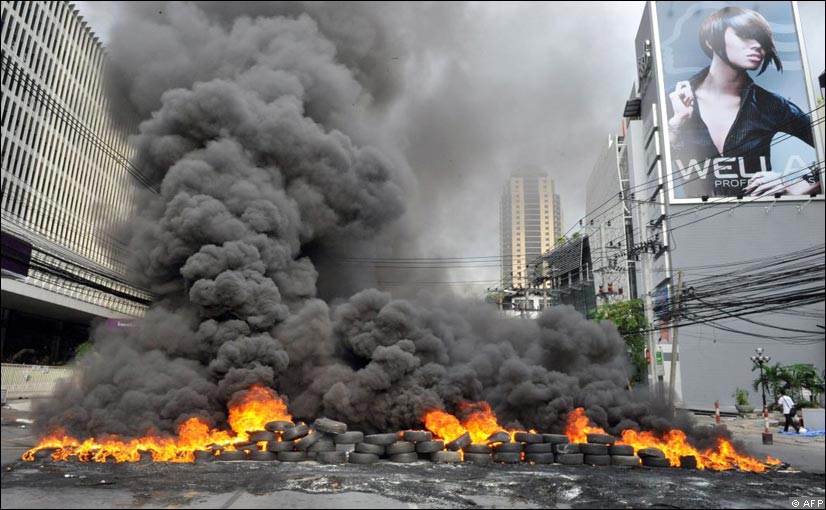
If you think the Mi’kmaq tire fires are bad, check out this massive one set by Red Shirts in the downtown financial district of Bangkok, Thailand, 2010.
The main complaint being expressed by detractors of this tactic is that it is bad for the environment. Some are clearly attempting to undermine the Mi’kmaq resistance by portraying this as a hypocritical act: fighting toxic pollution by lighting toxic fires. But the effects of tire fires, while producing toxic fumes, is minor compared to the devastation that fracking would cause to land and water.
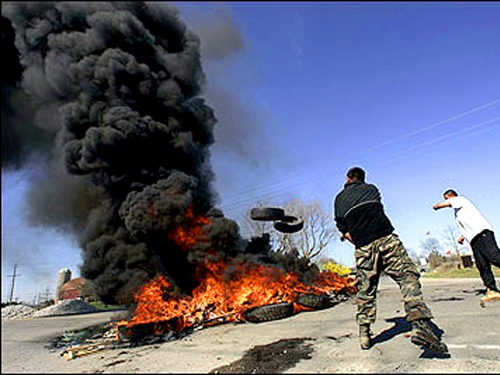
Tire fire blockade at Six Nations, April 2006.
The idea being expressed, that the warriors don’t care about the environment, is laughable. They have been fighting for months against SWN’s exploratory testing, enduring police assaults and arrests, pepper spray, and bean bag rounds. They are doing this to defend their land and water.
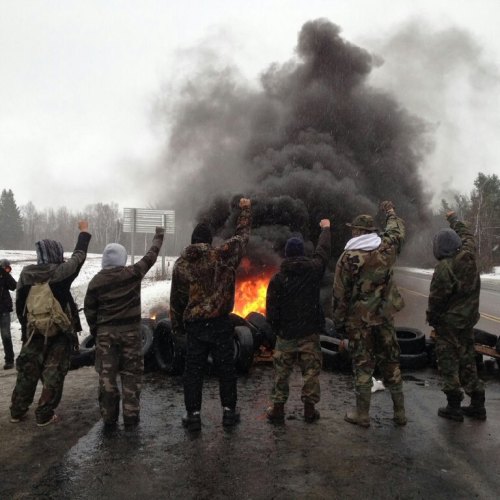
Mi’kmaq warriors on Hwy 11, Dec 4, 2013.
There are many more serious causes of toxic pollution than a few dozen tires set on fire on a rural highway. The daily commute of vehicles along highways, roads and city streets alone causes far more pollution than the Mi’kmaq tire fire blockades. So too do many industrial practises, such as factories producing a wide variety of products from toilet paper to the Tar Sands in northern Alberta. Before people start complaining and second-guessing the Mi’kmaq’s tactics, they should go out and stop some of these vastly more environmentally destructive practises.
Update: Shale gas protest closes Highway 11 again
Protesters burning tires, RCMP rerouting traffic
CBC News, Dec 04, 2013
Anti-shale gas protesters have blocked Highway 11 near Rexton again, say RCMP.
Burning tires and pallets are stretched across the highway.
RCMP have closed the highway between exits 57 and 64. Traffic is being rerouted and motorists are being advised to expect delays.
Police also arrested one protester for mischief earlier in the day. They say the man was in the middle of the road, impeding traffic.
On Monday, about 100 protesters blocked the highway for several hours with a tire fire after a judge agreed to extend SWN Resources Canada’s injunction to keep protesters from interfering with the company’s exploration work in the area.
Under the terms of the injunction, protesters must stay 20 metres away from the side of roads where the company is working and 250 metres away from the front or back of its trucks.
SWN Resources now has until Dec. 17 to complete its seismic mapping of the area.
http://www.cbc.ca/news/canada/new-brunswick/shale-gas-protest-closes-highway-11-again-1.2451099
It is no secret to lawyers and human rights activists that international refugee law does not accomodate those who lose their homes due to anthropogenic climate change.
New Zealand’s denial of a claim for refugee status by a man from Kirabati has confirmed this standard analysis. The Kirabati islands are low-lying, and are increasingly inundated due to rising sea levels.
But loss of one’s home-land due to climate change is not a form of political persecution, and so does not meet the legal standards for refugee status.
Despite the failure of this plaintiff’s bid to up-date New Zealand’s refugee laws, the suit demonstrates the clear need for new law.
The UNFCCC COP-19 meeting that concluded last week in Warsaw arrived at important agreement on the REDD+ program (see the as-yet unofficial documents here). REDD stands for Reducing Emissions from Degradation and Deforestation. REDD+ functions, to be very brief, as a means of enabling the preservation of tropical forests. These forests are largely in less developed countries (for example: Brazil, Peru, Indonesia). Industrialized countries can essentially buy up the forests as carbon sinks and then claim the amount of carbon absorbed by the forests as part of the reduction in green house gas emissions they have pledged to meet. In essence, the less developed countries sell the right to develop on their forested lands, and industrialized countries maintain their high emissions by relying on this lack of development in the global south.
In order to get less developed countries to agree to the REDD+ program…
Meanwhile, objections that those who live in and depend on the forests will lose their livelihoods and cultures if the forests are cordoned-off as carbon sinks are addressed via the good governance provisions in REDD+.
It is easy to see why forests have generated attention in the UNFCCC processes. Forests and the lands they occupy are valuable. They are valuable now as carbon sinks. Previously they were valuable both for their timber and as potential sites for cattle ranches or palm oil plantations. (Nothing in REDD+ seems to prohibit oil or gas extraction in the forests, provided the trees are left largely in tact).
Deserts, however, present a less attractive proposition for the global policy makers and the global economy. Deserts have little economic value– no trees, no fertile soil, no water. True, underneath the parched sands might lie minerals, oil or even water, but largely the deserts lands are not attractive to industrialized countries seeking carbon offsets.
Desertification, however, is a major facet of anthropogenic climate change. The human suffering from desertification is already significant. For example, the desertification of Mauritania has compounded the suffering the Haratine and Negro-African Mauritanians.
Mauritania has the dubious distinction of topping the list of countries with enslaved populations, according to the Global Slavery Index.
While the national government of Mauritania has received funds for climate change adaptation and mitigation, relief for these extreme victims of climate change thus far is not provided via the UNFCCC processes or protocols.
We’ve been seeing a lot of reports of protests at the COP 19 negotiations in Warsaw. Protestors are targeting the heavy presence of corporate interests at these negotiations. The COP (that’s Conference of the Parties to the UNFCCC) is supposed to be dedicated to diplomatic policy-making to reduce green house gas emissions.
Warsaw, however, is awash in fossil-fuel corporate presence. Amy Goodman from Democracy Now has an excellent segment that sheds light on this disturbing contradiction. Goodman is following up on the NGO report, COP 19 Guide to Corporate Lobbying.
https://twitter.com/search?q=%23freethearctic30
Greenpeace ✔ @Greenpeace Follow
RTCC Nov 11 with full transcript: Philippines negotiator Nasarev (Yeb) Sano declares hunger fast.
THE FOLLOWING IS QUOTED FROM COP-19 COLLECTIVE BLOG
“Excerpt [from Yeb Sano’s transcript]:
These last two days, there are moments when I feel that I should rally behind the climate advocates who peacefully confront those historically responsible for the current state of our climate. These selfless people who fight coal, expose themselves to freezing temperatures, or block oil pipelines. In fact, we are seeing increasing frustration and, thus, more increased civil disobedience. The next two weeks, these people, and many around the world who serve as our conscience will again remind us of our enormous responsibility.
To the youth here who will constantly remind us that their future is in peril, to the climate heroes who risk their lives, reputation, and personal liberties to stop drilling in the polar regions and to those communities standing up to unsustainable and climate-disrupting conventional sources of energy, we stand with them…
In solidarity with my countrymen who are struggling to find food back home and with my brother who has not had food for the last three days, in all due respect Mr. President, and I mean no disrespect for your kind hospitality, I will now commence a voluntary fasting for the climate. This means I will voluntarily refrain from eating food during this COP until a meaningful outcome is in sight.”
AFP Nov 12: In an unprecedented move, 30 Asian and youth delegates from Sri Lanka, Ukraine, Poland, India and the United States, joined the fast. “Some are fasting in solidarity with Mr. Sano with no food whatsoever, just water, to the end of the summit, or until real progress is made,” said Anjali Appadurai, of Friends of the Earth Sri Lanka.
“Climate justice now!” protesters at one of the conference venue’s many busy cafeterias wore large red dots on their lapels as a symbol of solidarity with the Philippines envoy and touted signs reading: “It’s lunch time but we’re not eating”, “We stand with you, we stand with the Philippines”.
Lydinyda Nacpil, of Jubilee South Asia Pacific Movement on Debt and Development (APMDD), called for “ambitious compensation and finance, reparations, solidarity and ambition and overall equity”.
RTCC Nov 12: Sano said he was “deeply touched and profoundly moved” by the decision of many youth delegates to fast for 24 hours or the rest of the summit.
According to Sönke Kreft of Germanwatch, extreme weather in the past 20 years killed around 30,000 people, causing US$2.5 trillion damage.
RTCC Nov 10: Sano is under no illusions that one storm will change what has become a set of convoluted, tough and often bitter negotiations. He urged compensation for loss and damage due to climate change. Despite vague promises of ‘fast start’ GCF funding, “We have not seen any money from the rich countries to help us to adapt.” Economic costs to the Philippines will exceed typhoon Bopha’s US$ 750 million; Haiyan has killed at least 10,000 (and probably more, as reports come in).”
Roy Scranton’s NY Times Op-Ed stands as a scathing indictment of all those pursuing climate change adaptation. Scranton argues that our civilization is already dead, we must accept that and build a new world. Adaptationists work to build a more-of-the-same world, just with sea walls and water-proof cellars.
But of course, even if it is dying, our civilization is not yet dead. It might not even be dying. It might be on the cusp of technological break-throughs that transform it in dramatic, unforeseeable ways.
Scranton is like a 21st Century Ernst Junger, writing a new Storm of Steel. His essay is an ode to death and destruction. Like Alan Weisman’s The World Without Us, it is a macho-masochist love song to annihilation.
Powerful and provocative, the appeal of such hype wears off quickly. It’s like a lazy afternoon fantasy that dissipates in the faintest breeze.
Because, really, we (our collective civilization) aren’t dead. Really, we will not die off because of global warming. Really, we will not get out of this pickle so quickly or with so little time for niggly-detailed-working-out-of-how-to-get-through-this. The process could be horrible. Many people no doubt will die. But there will be no definitive whole-globe cataclysm of death and destruction merely because of global warming. Of course, we live permanently under the threat of nuclear annihilation, but that is not cause or consequence of global warming.
So, no, don’t learn to die in the anthropocene. Learn to live.
****
Post-script (for a deeper cut):
Scranton describes his inspiration for making it through a tour of duty in the Iraq War and then draws on this as his model for how to “die” in the anthropocene. He writes, “I found my way forward through an 18th-century Samurai manual, Yamamoto Tsunetomo’s “Hagakure,” which commanded: “Meditation on inevitable death should be performed daily.” Instead of fearing my end, I owned it. Every morning, after doing maintenance on my Humvee, I’d imagine getting blown up by an I.E.D., shot by a sniper, burned to death, run over by a tank, torn apart by dogs, captured and beheaded, and succumbing to dysentery. Then, before we rolled out through the gate, I’d tell myself that I didn’t need to worry, because I was already dead. The only thing that mattered was that I did my best to make sure everyone else came back alive. “If by setting one’s heart right every morning and evening, one is able to live as though his body were already dead,” wrote Tsunetomo, “he gains freedom in the Way.””
Radical acceptance leads to radical freedom would be one way of thinking about this. But the glorification of the death and dying are not intrinsic to radical acceptance.
So please, let’s reconsider the automatic genuflection to military might. I protested the Iraq War before it began and I protest it now. The Iraq War was a misbegotten, illegal fiasco. Those who served in it are to be pitied, much like the civilian victims of our ‘shock and awe’ campaign.
Scranton got through the war by cultivating a military philosophy. Radical acceptance is a much larger vision. It can be appropriated by the tanks-and-guns crowd, but let’s not reduce it to such a militaristic creed.
We can live in acceptance of the anthropocene without the Rambo-style. And really, bringing such a militaristic ethos is very much “more-of-the-same”. It is a confirmation of the militarization of climate change politics. La plus ca change.
This is the new normal of the Anthropocene. Extreme weather leading to devastating loss of life and property is like a lottery system for who will suffer the brunt of anthropogenic global warming.
Global political response to such sporadic and far-flung destruction is inept. The current conference of the parties to the United Nations Climate Change Convention is being held in Warsaw, Poland. Coal energy is the stalwart of Poland’s economy and advocates of this fossil fuel were expected to have a strong voice at the negotiations.
Haiyan has intruded into the negotiations.
The Philippines envoy, Naderev Sanyo, to the Warsaw meeting broke down in tears as he addressed the gathered negotiators. “”We can fix this. We can stop this madness. Right now, right here,” Sano told delegates in Warsaw.
“Choking on his words, he said he was waiting in agony for news from relatives caught in the massive storm’s path, though he was relieved to hear his brother had survived.
“In the last two days he has been gathering bodies of the dead with his own two hands,” Sano said.”
Whipped by too many extreme storms — like Hurricane Sandy, Hurricane Katrina, and the Tsunami that took out the Fukushima Reactor — the latest super-storm induces numbness and disbelief. The causes leading to such extreme weather are very complicated, so directly attributing any specific storm to global warming is difficult if not impossible. Still, scientists have long predicted an increase in extreme weather as a part of global warming.
The leaked draft of the newest report from the United Nations Intergovernmental Panel on Climate Change (IPCC) points to decreased agricultural production as a major challenge of climate change. The threat to agriculture arises from the projected increased occurrence of droughts and floods.
Named Typhoon Haiyan, this storm is reportedly the strongest ever recorded to hit land. Winds reached 200 miles per hour. Some 10,000 people are feared to have died. Vast numbers of trees, buildings, and urban infrastructure have been destroyed.
Haiyan hit about 400 miles south of Manila, first thrashing the southern tip of Samar island and then devastating Leyte Island. Tacloban was laid to waste. Altogether the typhoon’s path crossed six or seven islands in the Philippines.
This map of Haiyan’s trajectory is from the NY Times — go to this link for a better image and for details on the damage:

President Obama’s administration recently announced the the United States would no longer finance the building of new coal fired power plants. This new policy marks an achievement long sought by environmental groups.
However, powerful international financial institutions, such as the World Bank, have not followed suit.
The president’s new policy meshes with the domestic policy that requires all new coal fired plants to use carbon capture and storage technology. Carbon capture and storage is expensive to implement. Moreover, there is no easy design for carbon capture and storage that can be commercialized.
Reuters reports:
“Nov. 7, the U.S. Department of Energy announced that it was awarding a total of $84 million to 18 research projects intended to find a lower cost way of capturing carbon dioxide (CO2) emissions from power plants.
The projects will test new solvents and sorbents to separate CO2 from other gases in power plant exhaust streams.
The aim is “improve the efficiency and drive down the costs of carbon capture processes for new and existing coal-fired plants,” according to officials.”
Ernest Moniz, Secretary of the Department of Energy, maintains that CCS is a viable technology, ready for implementation. But if CCS were ready for implementation, then why is the federal government spending $84 million to sponsor basic research into it?
Many allege that in fact the new restrictions on coal fired plants are intended to strangle the coal industry, forcing a turn to natural gas (obtained largely via fracking) and renewables.
***
The World Bank, meanwhile, has a new policy of supporting renewable energy — but so far it does not adhere to it. President of the World Bank, Dr. Kim, used to be a fierce critic of destructive development policies. Dr. Kim, however, has recently rejected criticisms of the IFC branch of the WB and how the IFC has supported the Tata Mundra mega coal power plant in Gujarat India.
Whether the WB will also support construction of new coal fired power plants in Kosovo is the next benchmark.
The Real Cost of Coal, published by the Bank Information Center (or, BIC), is at the origins of the Tata Mundra complaint of violations by the IFC of their own social and environmental safeguard standards. The official reports and documents on the Tata Mundra investigation are available on BIC’s site.
As reported on WC Native News:
The “major failure” of a pit at an Alberta coal mine has released one billion litres of contaminated water into the  Athabasca River. Athabasca River.
The breach at the Obed Mountain Coal Mine has resulted in murky water entering two tributaries, which carried the refuse into the Athabasca and is now visible in the river in the form of a muddy plume, states the Alberta Energy Regulator (AER.)
“Coal mines typically have a pit where the waste and water – coal dust and water – gather. And that pit, the open pit that contains that mixture, failed,” Darin Barter, a spokesperson with AER, told Global Edmonton.
“It’s our understanding that the water has entered two tributaries in the Athabasca River.”
The pit, which is located approximately 30 kilometres east of Hinton, failed during Halloween, stated the AER.
These kinds of incidents are rare, Barter told the Edmonton Journal, adding he was surprised it happened.
An employee at Sherritt International, which owns the mine, told the Edmonton Journal in anonymity the material in the pit is inert and non-toxic to people and wildlife.
But the province isn’t taking chances.
Water samples were taken from the plume and are being analyzed by independent labs and will make those results public as soon as they are available, Robyn Cochrane, Alberta Environment spokesperson, told Global Edmonton.
The leading edge of the plume is slowly dissipating and as of Sunday was located between Whitecourt and Athabasca, the Journal reports.
Investigators don’t know the actual length of the plume because aircraft needed to make the assessment were grounded due the weekend’s heavy snowfall, added the Journal.
Operation at the mine was suspended last year, due to what’s believed to be overwhelming economic and market pressures, and is currently undergoing reclamation.
source
Tags: Aboriginal, Alberta, breaking news, canada, First Nations, government, health, Idle No More, native news, pipeline leak, rights
|
|